
Secrets of the good life
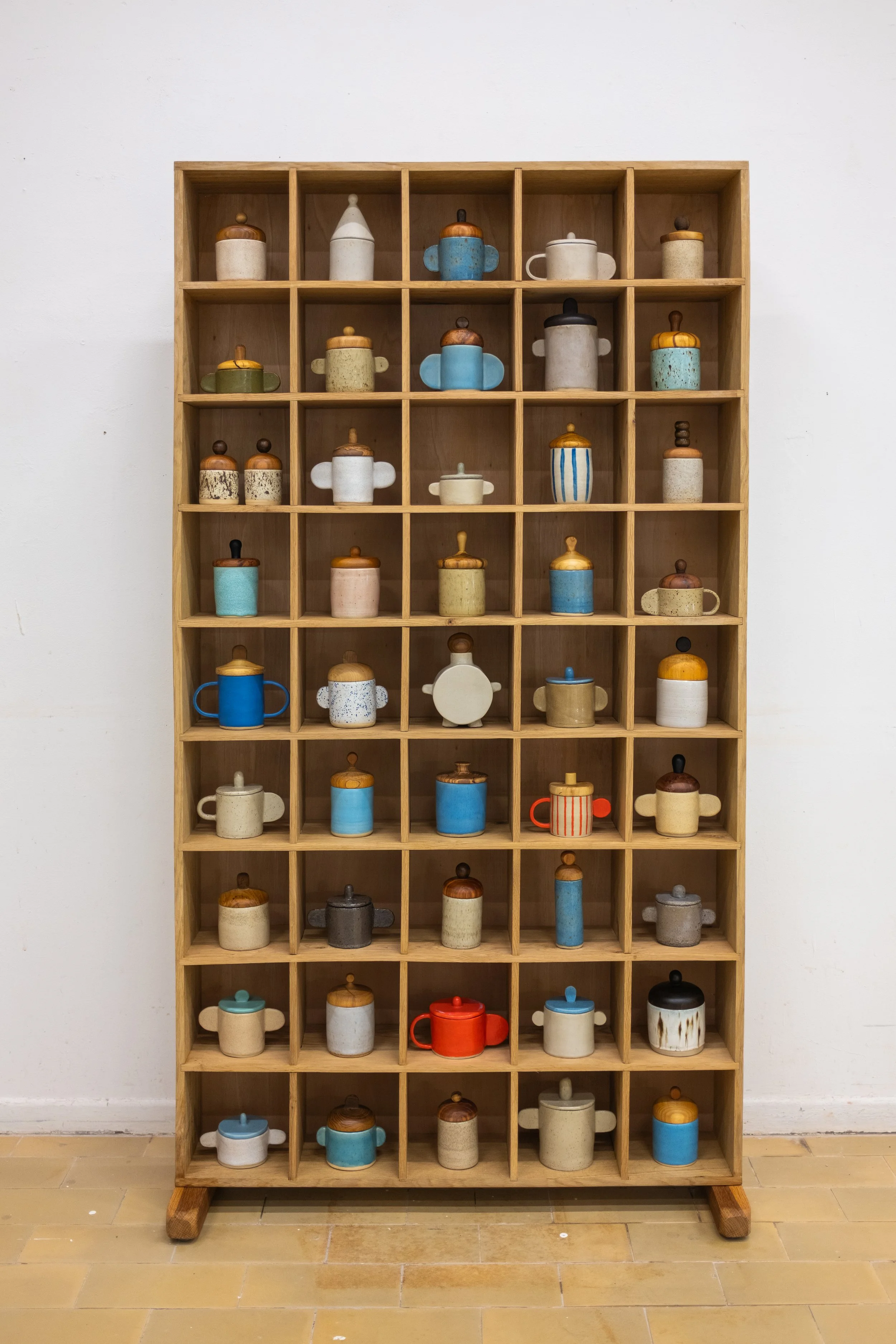
Secrets of The Good Life is a collection of ceramic pieces created over five years. When arranged in an organised and repetitive display, they resemble a pantry.
William Morris wrote in Useful Work versus Useless Toil (1884):
"The true secret of happiness lies in taking a genuine interest in all the details of daily life.”
This project celebrates precisely those details by focusing on simple containers, objects connected to domestic care.
The title Secrets of the Good Life was also inspired by a chapter in Jason Hickel’s book on Degrowth, in which he reflects on how well-being does not necessarily arise from accumulation or economic growth, but rather from the quality of everyday life and relationships. The phrase seemed particularly fitting for this project. Each object can be seen as a small ‘secret’ to a good life: sharing food, spending time together, caring for others, maintaining a home, and cultivating humour and hospitality.
A jar is first of all practicall: it stores food. Yet even in its simplest use, it carries meaning. As Jean Baudrillard observes in The System of Objects, no object is ever purely functional; each participates in a network of social and cultural significance. Ordinary objects shape how we live, relate to others and experience the world. Within a pantry, each piece contributes to a larger system of meaning, telling the story of a household, and the values it embodies. This project builds on that premise, using the pantry as a framework to explore how everyday objects help construct the idea of ‘home’.
The Romanian Pantry
My reimagined pantry is first of all an expression of my life-long love for pantries in my homeland, Transylvania.
Romanian pantries (‘cămară’) are a little world of their own. Inside, you will typically find: shelves packed with jars of homemade spreads, pickles, jams, tomato sauce, strings of dried peppers, garlic braids, crates of potatoes, and onions, bottles of homemade plum brandy etc.
The pantry is a symbol of security, hospitality and care. A full ‘cămară’ means the family is provided for all through winter and that the household is run by good ‘gospodari’. The Romanian word ‘gospodar’ doesn’t have a perfect one-word match in English, but it translates roughly as: hard-working-resourceful-good homemaker. A well-stocked pantry is a home’s pride (while an empty pantry can symbolise hardship or neglect). Grandparents will always insist you take a jar ‘for the road’, uncles will cheerfully and persistently try to get you tipsy on shots of plum brandy, and parents will send packages filled with jars and provisions.
I see thus ‘the jar’ as a bearer for the values that surround the Romanian pantry - care, hospitality, humbleness, honesty, kindness, and wisdom; values which I believe are also ‘secrets’ to living a good, wholesome life.
‘Pottery is art and pottery is craft’ (Jennifer Lucy Allan)
If the Romanian pantry provides the spirit of this work, its making is informed by the British Arts and Crafts movement and Japanese craft philosophy, Mingei. Both emerged as reactions to industrialisation and the decline of traditional craftsmanship, sharing a deep appreciation for the beauty of ordinary domestic objects.
In nineteenth-century Britain, artists and designers associated with the Arts and Crafts movement advocated for careful making, honesty of materials, and thoughtful design in everyday objects. One of its central figures, William Morris, expressed this ideal in The Beauty of Life (1880):
“Have nothing in your houses that you do not know to be useful, or believe to be beautiful.”
Morris challenged the distinction between “fine” and “applied” arts, arguing that art and craft have historically formed a unified practice.
A related perspective can be found in Japanese craft philosophy, particularly in the ideas articulated by Soetsu Yanagi and the Mingei movement. Like Morris, Yanagi calls the ‘unhappy separation of the arts and crafts’ ‘a modern-day tragedy’. In The Beauty of Everyday Things and The Unknown Craftsman, he highlights the quiet beauty of humble, functional objects shaped by necessity.
Following the ideas advocated by William Morris and Soetsu Yanagi, I too believe that the division between art and craft is a false opposition. If a ceramic jar can store pickles and ontological questions, asking whether it is art or craft seems unnecessarily administrative.
Jar Psychology
A jar is ambiguous, self-contained, selectively open, essentially the otrovert of the kitchen. A plate is the extrovert, happily displaying the food to the world, while a cup is the introvert, designed for intimate encounters. The jar avoids unnecessary interaction and is perfectly content being left alone for long periods of time, holding beans, pickles, tea, and the occasional secret. I have chosen the jar because it reflects something of my own personality; I too prefer a lidded existence.
The Architecture of Happiness
Alain de Botton describes in The Architecture of Happiness how beautiful environments matter not only for their visual qualities, but because they give form to the values we aspire to live by, shaping experiences of calm, creativity, and well-being:
“A feeling of beauty is a sign that we have come upon a material articulation of certain of our ideas of a good life.”
The cabinet is a modest architectural structure, a small building for objects. It organises the jars in a strict grid, where repetition creates order while allowing each piece to retain its individuality. Together, they form a dense visual field, much like shelves of a well-stocked pantry. The result is an ordered cheerfulness, where structure brings clarity and variation adds warmth and subtle humour.
I did not wish to construct a literal, warm and cosy Romanian cămară, as this would have resembled a theatrical set rather than a space for reflection. Instead, the cabinet distills the experience of the pantry into a more abstract and essential form. In an exhibition context it is sober and detached, yet it can be activated in a domestic setting.
If, as de Botton suggests, happiness can be shaped through architecture, then the pantry can be understood as a small-scale architecture of well-being. The jars exist between function and sculpture, forming an installation that reflects how everyday domestic objects shape our sense of ‘home’ and ordinary life.
At home
Perhaps because I have always lived between cultures (Romania, Canada, the UK, the Netherlands, Belgium…) and moved frequently, ‘home’ has never been a fixed place. Although I do not have a single point on the map pinned as ‘home’, I do know very well where I feel ‘at home’. A home as a physical space, a house, is shaped by architecture, geography, and building regulations. But feeling at home is something else entirely; it is created through imagination and connection.
Emanuele Coccia, an Italian philosopher based in Paris who, like me, has lived in many places and therefore questioned the idea of home, explores this theme in Philosophy of the Home. He suggests that a home is not just a physical shelter, but a space where relationships between people, objects, memories, and everyday gestures continuously take shape. In this sense, home is something we actively create through ‘homemaking’: the ongoing way we arrange, use, and inhabit our surroundings. Within this process, objects are not passive belongings but active participants in daily life, helping to shape moments of intimacy, hospitality, and care:
“It is only by revolutionising the way in which we give form and content to the experience of home that we will manage once again to make the world a place where a common, shared happiness is possible.”
“Happiness is the arbitrary and transitory harmony that brings together objects and people in a relationship of physical and spiritual intimacy.”
“Homes do not exist per se. Only homemaking exists.”
This perspective aligns with Yanagi’s view that everyday things quietly participate in the ‘homemaking’ process:
“Commonplace objects are in fact our loyal companions, our faithful friends, willing to help out when help is needed. There is not one of us who doesn’t rely on them throughout the day. The beauty we see in them is honest and sincere, an expression of humility.”
“Living with them day in and day out, they took on a warm familiarity. Surrounded by them, people felt comfortably at home.”
Ultimately, the objects in Secrets of the Good Life are made with precisely this intention: to help create a sense of home. I tried to give form, in my jars, to the virtues of a good friend: down-to-earth, good-humoured, kind, cheerful and warmly approachable. Constructing and filling a pantry with ceramic jars can be seen as an act of ‘homemaking’, revealing how thoughtful objects have the capacity to transform houses into homes.